Korean brands can no longer grow in the U.S. market with “good products” alone. In 2026, content, e-commerce, performance advertising, SEO, GEO, and AI search visibility need to be planned together as one connected growth structure.
The key is to design every touchpoint from discovery to purchase. TikTok, Amazon, Shopify, Google, Meta, Reddit, and AI search each play different roles, but when they are operated separately, growth efficiency becomes limited.

Many Korean brands ask similar questions when thinking about the U.S. market.
“How can we sell in the U.S.?”
“Should we start with Amazon?”
“Will Meta ads generate sales?”
“Is going viral on TikTok enough?”
But in 2026, the more important question is this:
Where do U.S. consumers first discover our brand, what makes them trust it, and when do they decide to buy?
The U.S. consumer journey is no longer linear. Consumers may discover a product on TikTok, search for real reviews on Reddit, compare options on Google, check reviews and pricing on Amazon, and also see how the brand is described in AI search results.
The issue is not simply that there are more channels. The bigger shift is that each channel now plays a different role in the consumer decision-making process.
TikTok creates interest. Amazon provides trust and purchase convenience. Shopify builds brand experience and repeat purchase structure. Google captures existing demand. AI search environments such as Google AI Overviews, ChatGPT, Gemini, and Perplexity are also changing how brands are summarized and recommended to consumers.
That is why global marketing in 2026 is not just about running U.S. ads. It is about designing how a brand is discovered, explained, compared, and purchased. In this process, Performance Marketing Strategy, which interprets U.S. consumer search intent and purchase journeys through advertising data, becomes a key standard for deciding which messages and channels a brand should prioritize.
Korean beauty already has strong attention in the U.S. market. But attention does not automatically become revenue. Brands that grow sustainably in the U.S. do not simply bring “popular Korean products” into the market. They build a problem-solving structure that U.S. consumers can clearly understand.
Medicube is a strong example of this shift. According to Vogue, after Kylie Jenner mentioned Medicube on TikTok, 5,000 people visited its LA pop-up over one week, and more than 670,000 TikTok posts related to Medicube were created. Medicube also generated $22 million in Amazon Prime Day sales, more than $9 million during Black Friday across Amazon, TikTok Shop, and its own website, and expanded into more than 1,400 Ulta Beauty stores in the U.S.
Source: Vogue
The key point is not that the brand succeeded because a celebrity mentioned it. The real point is that Medicube connected TikTok-driven attention to Amazon, TikTok Shop, its own website, and offline retail expansion.
Vogue also explains that Medicube’s TikTok Shop sales increased 1,143% from 2024 to 2025, cumulative TikTok Shop sales exceeded $102.9 million, and the brand secured around 34,000 affiliate creators. This structure is closer to creator-driven commerce infrastructure than short-term viral buzz.
Source: Vogue
One common mistake Korean beauty brands make when entering the U.S. is describing products too much from the brand’s perspective. Messages such as “premium,” “high quality,” “popular in Korea,” and “natural ingredients” are already used by too many brands.
U.S. consumers care more about these questions:
The core of Korean beauty marketing in 2026 is not simply that “K-beauty is popular.” The real question is how specifically Korean brands solve U.S. consumer problems and how convincingly they prove that solution.
To connect product discovery to actual purchase, entering Amazon is not enough. Brands need Amazon Marketing Strategy that connects product detail pages, advertising, reviews, search visibility, and brand storytelling.

Beauty brands can often be explained through ingredients, benefits, routines, and reviews. Fashion and lifestyle brands are more complex because purchases are not driven by function alone.
Clothing, accessories, and lifestyle products are connected to taste, identity, community, and social signals. That is why fashion and lifestyle brands entering the U.S. need to ask not only “what do we sell?” but also “which cultural context can we enter?”
The True Religion case covered by Modern Retail shows this clearly. True Religion responded to growing Gen Z customer interest by connecting college tours, paid Snapchat ads, college athlete partnerships, pop-up events, and its loyalty program. After its Von Dutch collaboration, site visits increased 40% year over year, and about 25% of its loyalty program members were aged 18–25.
Source: Modern Retail
The key point is not simply that the brand ran Snapchat ads. The brand entered spaces where Gen Z consumers were already active. College campuses, pop-up events, college athletes, social platforms, and loyalty programs worked together as one customer acquisition flow.
For Korean fashion and lifestyle brands to grow in the U.S., they first need to define which consumer group the brand can become meaningful to.
In the 2026 U.S. market, simply spending more on ads is not enough to create brand differentiation. Algorithms change quickly, consumers skip ads fast, and similar brand messages are easily ignored.
Fashion and lifestyle brands need a structure that moves from culture to performance. First, they need a cultural entry point. Then they should expand that signal through content, validate it through paid ads, and connect it to a commerce structure that makes purchase easy.
In this process, brands should not rely only on ads to persuade consumers. They need touchpoints where creators and communities can naturally interpret the brand. That is why Social Media and Influencer Marketing for the U.S. market should focus less on simple exposure and more on building cultural context.
One major change Korean brands need to watch in the 2026 U.S. market is paid search. As Google AI Overviews become part of the search results page, the way brands operate SEO and paid search is changing at the same time.
Search Engine Land explains that Google AI Overviews are affecting paid search clicks, cost-per-click, conversion behavior, and the purchase journey. According to the article, the paid ad click-through rate for queries with Google AI Overviews dropped from 19.7% in June 2024 to 6.34% in September 2025.
Source: Search Engine Land
This does not mean paid search is losing value. It means that a more precise operating model is becoming more important, one that connects search intent, conversion potential, and landing page messaging.
Google AI Overviews answers many basic questions directly. As a result, informational clicks may decline. However, high-intent searches, brand searches, and comparison searches still play an important role.
For Korean brands running paid search in the U.S., the key points are as follows:
For example, a broad keyword like “Korean skincare” may generate interest but may not have strong purchase intent. On the other hand, searches like “best Korean toner for acne-prone skin,” “Korean collagen mask available on Amazon,” or “Korean fashion brand with U.S. shipping” may be more specific and more likely to convert.
The key is not to add as many long-tail keywords as possible. Brands need to understand where each search query sits in the purchase journey.
Paid search is a tool that turns this journey into data. It shows which messages get clicks, which landing pages convert, and which keywords are most likely to lead to purchase.
Therefore, when Korean brands first enter the U.S. market, paid search should not be treated simply as ad spend. It should be used as a market-learning data system. When running Google, Meta, TikTok, and YouTube ads, brands need Performance Marketing Operation that analyzes search intent, conversion data, and landing page structure together.
Traditional SEO focused mainly on ranking higher on Google. That is still important. But in 2026, consumers are not only looking at a list of links. They are also looking at AI-generated answers, comparison tables, and recommendation lists.
In this environment, optimizing only for search engines is not enough. Brands need to be explained in a way that AI systems can understand. That is why GEO is becoming important.
The reason Korean brands need GEO in the U.S. market is simple. When U.S. consumers ask ChatGPT, Gemini, Perplexity, or Google AI Overviews questions like “best Korean skincare brand for pore care” or “best Korean fashion brand with U.S. shipping,” brands that are not mentioned may never enter the consideration set.
Important factors in AI search include the following:
Search Engine Land recommends analyzing Google Ads search term data in 90-day windows, separating informational searches from purchase-intent searches, and identifying which queries trigger Google AI Overviews in order to reset click-through rate and conversion benchmarks.
Source: Search Engine Land
This approach shows why SEO, GEO, and paid search should not operate separately. Paid search data reveals which search terms convert. SEO content shapes how the brand is understood in search. GEO strengthens the foundation for AI systems to summarize and recommend the brand.
Ultimately, search strategy in 2026 is not simply about “writing more blog posts.” It is about designing what kind of answer the brand becomes in search and AI environments. To do this, brands need AI Optimization and GEO Strategy, where content structure, external signals, and search data work together.
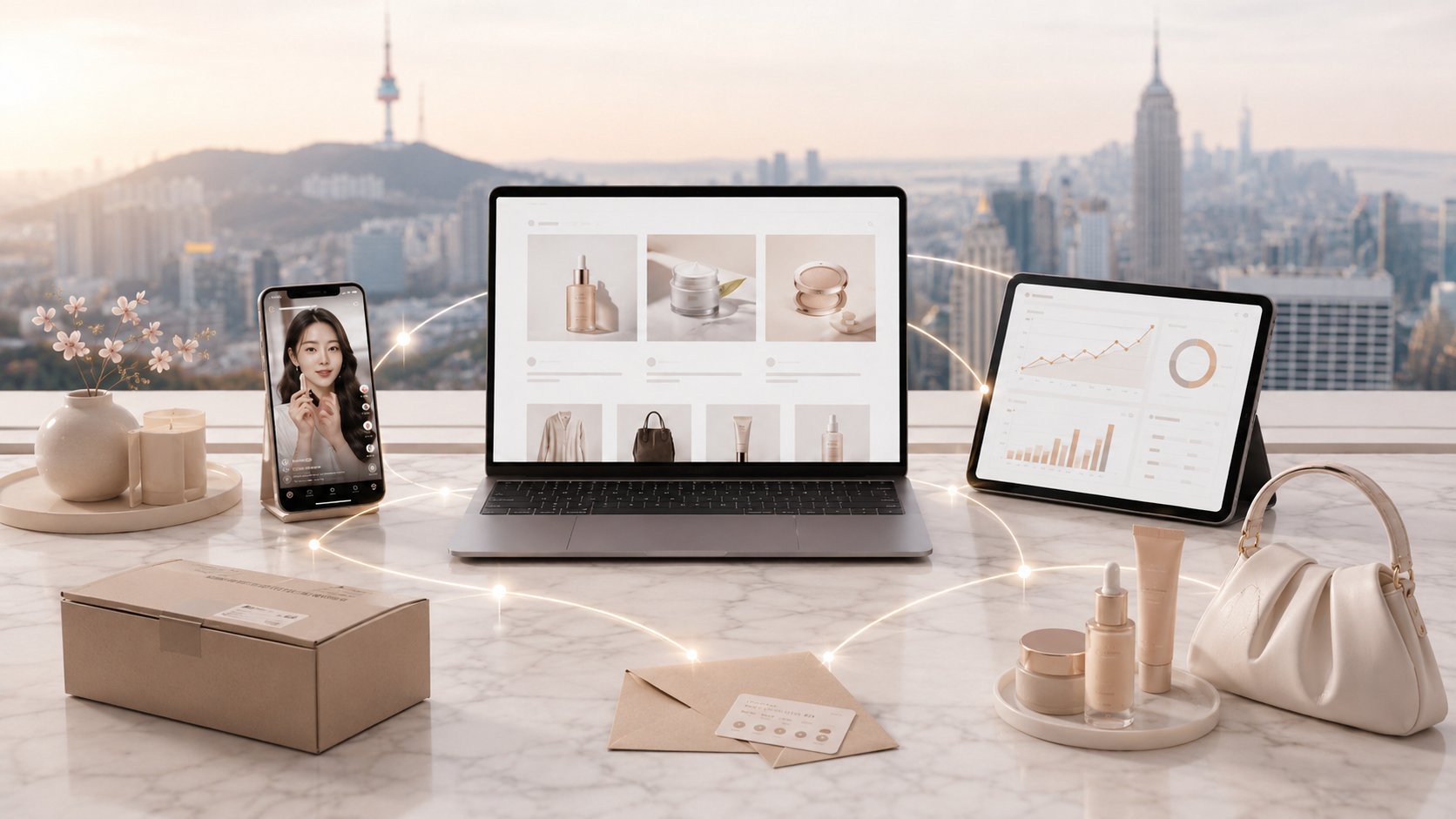
For Korean beauty, fashion, and lifestyle brands to win in the U.S. market, channels cannot be operated separately. If TikTok, Amazon, Google Ads, and SEO each operate in isolation, the consumer experience becomes disconnected.
The 2026 global marketing playbook needs to define each channel’s role clearly and connect those roles according to the consumer journey.
DISRUPT’s service structure also aligns with this flow. DISRUPT provides Amazon marketing, performance marketing, AI optimization and GEO, social media operation, influencer marketing, Shopify development and marketing, email marketing, content creation, Reddit reputation management, and ChatGPT advertising.
The reason many brands fail to grow in the U.S. is usually not because one channel is missing. Ads may be running, but the landing page may not persuade. TikTok views may be high, but Amazon reviews may be weak. SEO content may exist, but it may not connect to purchase intent.
In 2026, competitiveness comes less from “Which channel are we using?” and more from “In what order and role are we operating each channel?” Korean brands preparing for U.S. expansion should consider Integrated Global Marketing Service, where Amazon, performance advertising, GEO, Shopify, content, and influencer strategy are designed as one growth structure.