If you still think Prime Day happens in July, you’re already behind. Every year, brands ask the same question: “When should we start preparing for Prime Day?”
And every year, many brands repeat the same mistakes. Some secure large advertising budgets only to run out of inventory midway through the event. Others miss deal submission deadlines and are forced to compete without Prime badges during the highest-traffic period of the year. In many cases, brands invest heavily in advertising while their product detail pages remain unprepared for the sudden surge in traffic. Prime Day 2026, however, is fundamentally different. This is not simply a larger sales event. The structure of participation itself has changed.

Amazon has officially moved Prime Day from July to June, accelerating the entire operational timeline for sellers. This shift goes far beyond a simple calendar adjustment. Inventory inbound deadlines, deal submission schedules, and PPC optimization timelines have all moved forward by several weeks. While many brands continue operating according to last year’s schedule, Amazon’s marketplace ecosystem has already advanced to a new cadence.
At the same time, the economic environment surrounding Prime Day has evolved. Rising FBA fees and logistics surcharges are placing increased pressure on profitability. Discount strategies that were sustainable in previous years may now result in break-even performance or even negative contribution margins. As a result, brands can no longer approach Prime Day purely as a sales volume opportunity. Sustainable unit economics and margin management have become equally important as topline revenue growth.
Consumer behavior on Amazon is also shifting rapidly. Amazon’s AI shopping assistant, Alexa, is beginning to reshape product discovery across the platform. Rather than relying on short keyword searches, shoppers are increasingly using intent-driven queries such as “best Korean skincare for sensitive skin” or “high-protein snacks with low sugar.” This evolution changes how listings must be written and optimized. Keyword density alone is no longer sufficient; product pages now need to answer real customer questions using clear, natural language that AI systems can interpret, contextualize, and recommend.
Meanwhile, advertising competition continues to intensify. Cost-per-click inflation during Prime Day has become significantly more aggressive, particularly in competitive categories such as Beauty, Health, and Supplements. Brands with weak conversion foundations often end up paying premium traffic costs without generating proportional returns. Prime Day has therefore shifted from a traffic acquisition challenge to a conversion infrastructure challenge. For this reason, early preparation creates a disproportionate competitive advantage. Success in Prime Day 2026 depends on whether inventory planning, listing optimization, PPC strategy, and AI-driven search readiness are fully aligned well before the event begins.
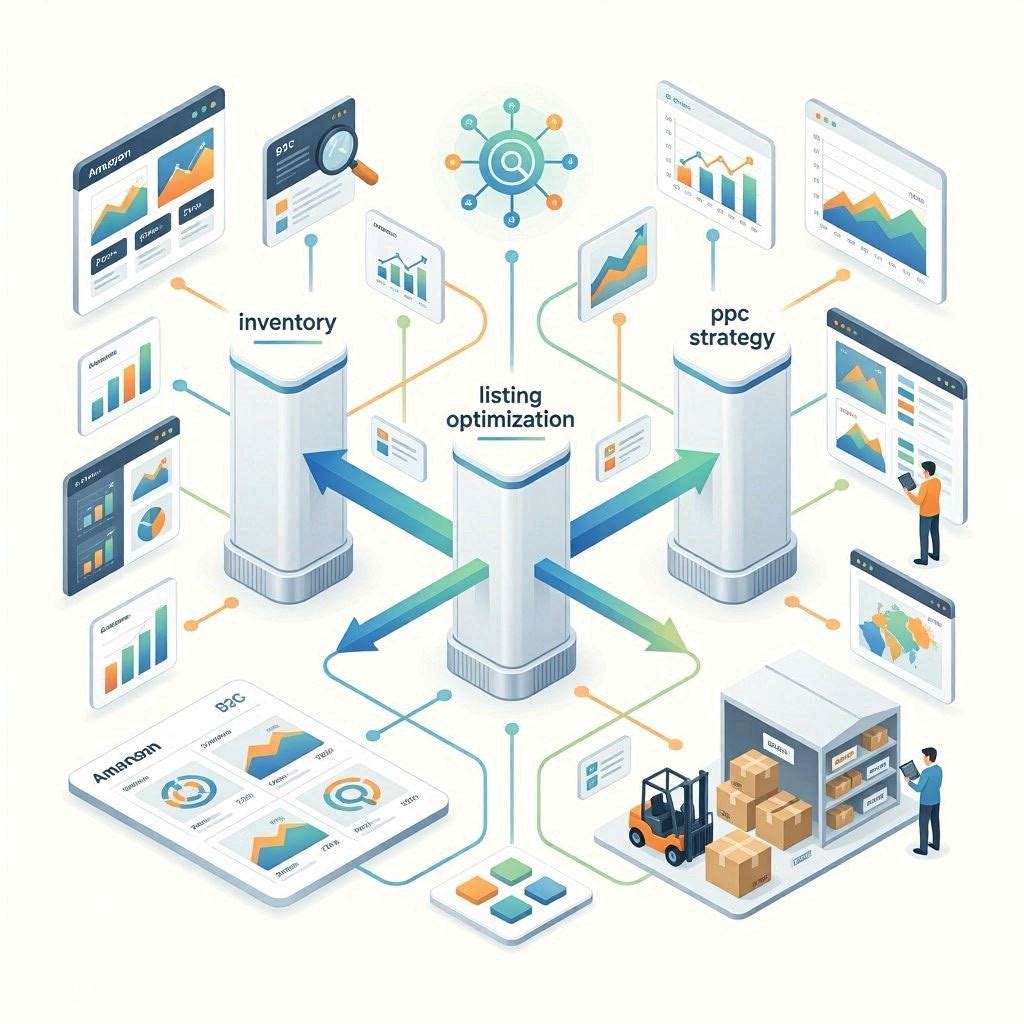
Inventory planning, listing quality, and PPC strategy must function as a single integrated system. One of the most common misconceptions about Prime Day is that it is primarily an advertising event. In reality, the highest-performing brands begin preparation months in advance. By the time traffic surges, most critical operational decisions have already been executed.
The first priority is inventory planning. During Prime Day, products carrying deal badges frequently experience demand spikes reaching two to three times their normal sales velocity. Despite this predictable pattern, many brands continue forecasting inventory based on historical averages rather than event-driven demand. This risk becomes even more significant in 2026, as the earlier event timing compresses manufacturing, inbound shipping, and warehouse processing schedules. Running out of stock during Prime Day creates consequences that extend far beyond temporary lost sales. Once inventory becomes unavailable, organic rankings can decline immediately, often resulting in reduced visibility even after the event concludes. To mitigate this risk, brands should secure at least 20–30 percent safety stock above projected demand while also preparing FBM backup fulfillment systems in case FBA capacity becomes constrained.
The second critical area is listing optimization. Prime Day consistently drives CPC inflation across nearly all competitive categories, making inefficient product pages increasingly costly. Brands frequently interpret declining performance as an advertising problem when the underlying issue is conversion efficiency. Weak main images, feature-focused bullet points, generic A+ content, and the absence of product video assets commonly reduce conversion rates during the most competitive shopping period of the year. In the era of AI-assisted shopping, listing structure has become even more important. Product pages must communicate benefits clearly enough for both shoppers and AI recommendation systems to interpret value quickly and accurately.
For example, a bullet point stating “contains collagen and hyaluronic acid” describes ingredients but fails to communicate customer impact. A stronger approach reframes the message around outcomes, such as “deep hydration support for dry, tired-looking skin.” Benefit-driven language written in natural conversational structure aligns far more effectively with how consumers now search through Alexa and other AI-assisted discovery environments.
The impact of structural listing optimization can be observed in the case of Korean skincare brand Dr.Reju-All. Prior to its official Amazon launch, unauthorized resellers had fragmented the brand’s presence across multiple listings, weakening brand control and search visibility. DISRUPT restructured the account architecture, rebuilt SEO-focused listings, and implemented an integrated advertising framework from the ground up. As a result, the brand achieved a Top 100 ranking in Amazon’s Face Moisturizer category within its first month after launch.
PPC strategy requires the same level of structural planning. Many brands simply increase budgets on existing evergreen campaigns during Prime Day. However, event traffic behaves differently from everyday marketplace traffic, and Prime Day campaigns should be operationally separated from standard campaigns.
Sponsored Products campaigns should prioritize high-margin ASINs and exact-match keywords with strong purchase intent signals. Sponsored Brands Video campaigns become particularly effective during Prime Day because they secure premium top-of-search placements when competition intensifies. Meanwhile, Sponsored Display campaigns are most effective when focused on retargeting audiences who interacted with product pages in the weeks leading up to the event.
A similar transformation occurred with global healthcare brand InBody during its early Amazon growth phase. Overreliance on automated campaigns had created inefficient spending and keyword overlap across multiple campaigns. DISRUPT rebuilt the advertising structure around product-level keyword targeting, improving both ROAS efficiency and overall sales performance. Ultimately, Prime Day performance is not driven by advertising alone. Sustainable success emerges when inventory readiness, listing quality, and PPC operations function as one coordinated growth system.

For many brands, Prime Day success is measured purely by sales generated during the event itself. However, the most sophisticated operators understand that the real opportunity begins after the event ends.
Execution during Prime Day still requires disciplined real-time management. CPC levels commonly increase by 40–80 percent compared to normal periods, particularly for high-performing keywords. Budget pacing, bid optimization, and continuous campaign monitoring therefore remain essential throughout the event window. Yet brands that focus exclusively on short-term revenue often overlook the larger strategic objective: customer acquisition and long-term ranking expansion.
Prime Day exposes products to an unusually large volume of first-time shoppers. The critical question is whether these customers disappear once discounts end or transition into repeat buyers who strengthen sustained organic growth. The brands that win treat Prime Day not as a temporary promotion, but as an accelerated customer acquisition moment.
One of the most immediate post-event priorities is review generation. Because sales velocity increases dramatically during Prime Day, the period immediately following the event becomes one of the fastest review acquisition windows of the year. Brands should activate review request automation within Amazon’s permitted framework to capture this momentum. Reviews function not only as trust signals for future shoppers but also as structural ranking assets that support organic visibility and improve advertising efficiency over time.
Equally important is post-event data analysis. Prime Day compresses a large volume of high-quality consumer behavior data into a very short timeframe. High-performing brands systematically analyze which ASINs converted most efficiently, which search terms delivered the strongest profitability, and which time windows produced peak conversion performance.
These insights directly inform Q4 strategy planning. Prime Big Deal Days in October, followed by Black Friday and Cyber Monday, create another period of intense marketplace competition. Brands that transform Prime Day performance data into operational learning gain a significant advantage during these later events.
The long-term impact of this approach can be seen in DISRUPT’s collaboration with K-beauty brand Biodance. After experiencing stalled momentum during its early Amazon expansion phase, the brand rebuilt its PPC architecture and optimized its listing ecosystem in partnership with DISRUPT. The result included multiple #1 Best Seller rankings within Amazon’s Beauty category and a 139× year-over-year revenue increase during its first major growth phase.
Prime Day is no longer simply a discount-driven sales event. It has evolved into one of Amazon’s most operationally complex growth opportunities, where advertising execution, AI-driven search optimization, inventory strategy, and data infrastructure converge within a single competitive environment. Brands that recognize this complexity early are ultimately the ones that capture lasting market share. DISRUPT partners with global brands to accelerate Amazon growth through Prime Day strategy development, PPC management, and conversion-focused listing optimization.

Account Executive
