Imagine a customer opens Amazon on their phone and types: "What's a good brightening serum for sensitive skin that won't cause purging?" A year ago, Amazon would have returned a grid of products and left them to decide. In 2026, something very different happens.
Amazon's AI shopping assistant, now known as Alexa for Shopping, reads your entire product detail page, cross-references your reviews, scans your Q&A section, and generates a summary answer in seconds. It decides whether your product is the right recommendation for their specific question before they ever click your listing. If your PDP doesn't explicitly mention "formulated for sensitive skin" or explain why there's no purging phase, the AI makes its best guess. Or it turns to your reviews to fill the gap. And if those reviews say "broke me out" or "too strong for my skin," that's what gets surfaced. They never see your A+ content. They never read your brand story. They move to the next product, and you never knew they were there. This is the reality of Amazon in 2026, and most brands are completely unprepared for it.
The instinct when bad reviews start rolling in is to interrogate the product. Bad batch? Quality issue? Sizing problem? But increasingly, the real culprit is something far more fixable: the listing itself. When a PDP says "suitable for all skin types," it sells the product to buyers it was never designed for. The buyer with eczema-prone skin purchases it. The product, excellent for its intended audience, doesn't work for them. They leave a 2-star review. That review now lives permanently on your page, and Amazon's AI is reading it, using it, and surfacing it to the next person who asks a similar question. That's not a product failure. That's a content failure.
AI-attributed sessions on Amazon now convert at meaningfully higher rates than traditional search, but only when the match between buyer intent and listing content is right. When it's wrong, you don't just lose the sale. You earn the bad review, which damages your next AI recommendation, which reduces your visibility, which compounds the problem. The feedback loop is quiet, slow, and devastating. For years, Amazon listing optimization was a keyword game. Find the high-volume terms, layer them into your title and bullets, and climb the rankings. That model is broken. Amazon's AI doesn't match keywords; it interprets intent. It reads your listing the way a well-informed friend reads a product page, looking for specific, honest answers to real-world questions. The question is no longer whether AI matters for your listings. It's whether your listing gives it anything worth recommending.

Most sellers assume Amazon's AI works like a smarter search engine: optimize your title, layer in the right keywords, and it picks you up. That's a logical assumption, but it's the wrong one. Amazon's AI shopping assistant doesn't match words. It evaluates meaning. When a buyer asks "What vitamin C serum won't oxidize quickly and works for combination skin?", the AI reads your listing and asks a very different set of questions: Does this page communicate, with enough specificity, that this serum is chemically stable and suitable for combination skin? Are those claims verifiable? Is the review sentiment consistent with what the listing promises? If the answers aren't clearly there, you don't rank lower. You fall out of the consideration set entirely.
The content it reads is also broader than most brands realize. Amazon's AI doesn't just scan your bullet points and title. It reads your entire PDP ecosystem simultaneously: the product description, A+ content modules, Q&A section, customer reviews, and structured backend attributes. It cross-references all of them against each other. If your bullets claim "gentle formula suitable for all skin types" but your reviews repeatedly mention "too harsh" or "caused a reaction," the AI detects the contradiction. Contradictions are a disqualifier. The system would rather skip your listing than risk sending a buyer conflicting information. Understanding how AI models parse this content is the foundation of LLM optimization, and getting it right starts with knowing what the AI is actually looking for. This is why brands with genuinely strong products still get passed over. The listing sends mixed signals, and when content conflicts, the AI defaults to whichever source it trusts most, which is almost always reviews.
What actually drives AI recommendations isn't a single well-written bullet. It's what researchers are calling a "pattern of consensus": a consistent story told across every available content surface. Consider two similar products in the same category. One has solid SEO, but its messaging varies across its Amazon listing, reviews, third-party publications, and community discussions. The other consistently earns praise for the same strengths everywhere people talk about it. AI is far more likely to recommend the second product because the evidence reinforces itself rather than conflicting. Your brand can build that same level of confidence, but it requires an intentional Amazon marketing strategy that treats your PDP and your review ecosystem as one unified system, not two separate problems managed by two separate teams.
Amazon's "Help Me Decide" feature, launched in late 2025, made all of this even more urgent. When a shopper is comparing two or three similar products, the AI steps in, picks one, and explains why, drawing directly from listing content and review sentiment. If your bullets and A+ modules don't clearly articulate what makes your product different from the competitor beside you, the AI uses your competitor's claim instead. You don't lose on price. You don't lose on design. You lose because your content wasn't specific enough to win a single sentence in a comparison summary.
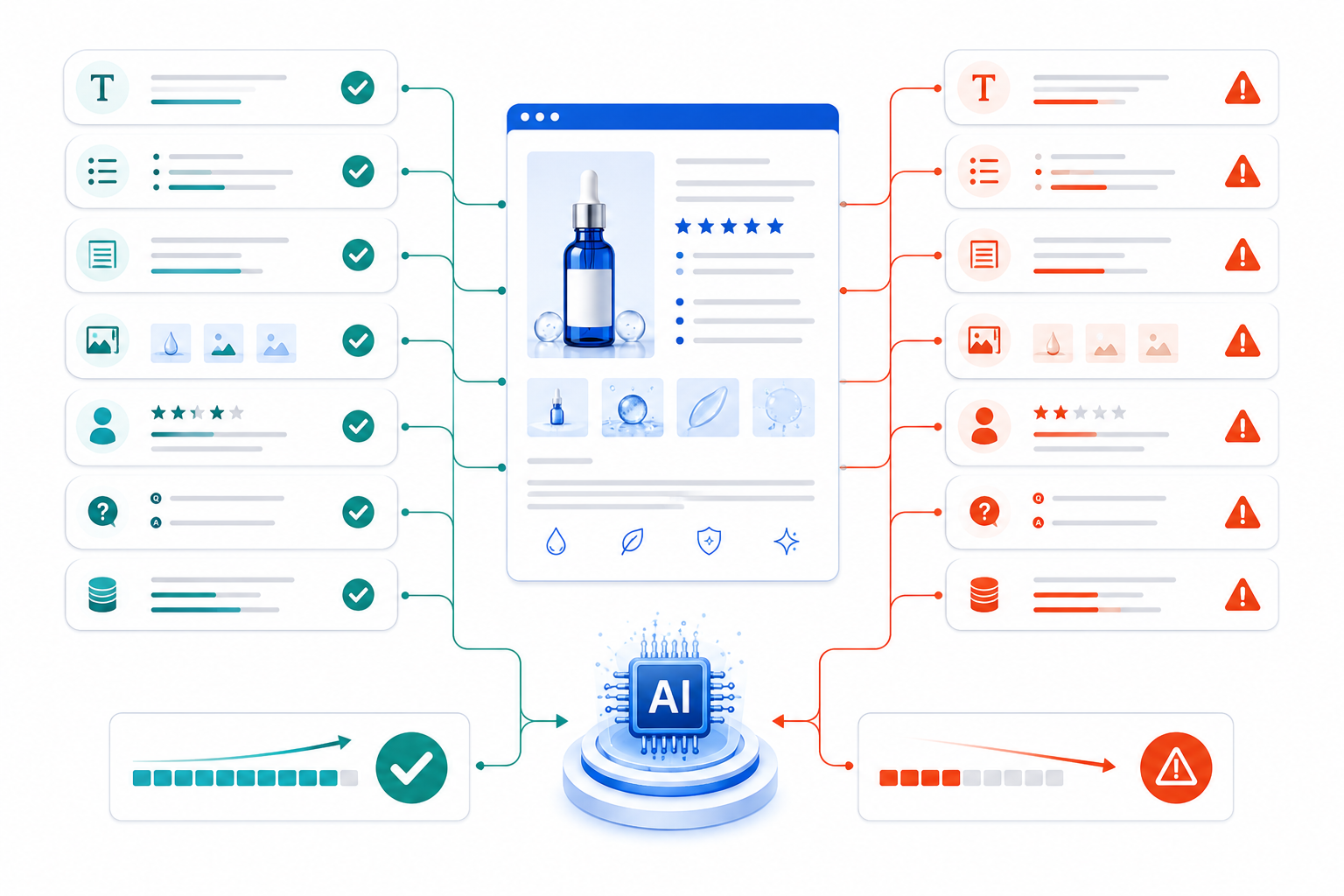
The good news is that this is entirely fixable. And the fix for winning AI recommendations is the same fix for preventing bad reviews, because both problems share the same root cause: the listing failed to communicate what the product does, for whom, and under what conditions.
Start by writing your PDP as though you're answering a knowledgeable customer's real questions, not filling a character-count template. Pull the top questions buyers actually ask from your Q&A section, your negative reviews, your competitor reviews, and your support inbox. Those sources are a research document. They show you exactly what your listing failed to explain before the purchase happened. Every bullet point should answer at least two of those questions in specific, claim-rich language. "Rust-proof design" tells the AI nothing it can verify or cite. "Chrome-plated finish creates an impermeable barrier against oxidation, tested rust-free after 500 consecutive dishwasher cycles" gives it a mechanism, a result, a condition, and a timeframe. That's the difference between being recommended and being skipped.
Then, define who your product is for and, when appropriate, who it isn't. This is the most underused tactic in listing optimization, and it's the most effective thing you can do to prevent mismatched buyers and the reviews they leave. Telling a buyer "for dry or sensitive skin, we recommend our Ceramide Barrier Cream instead" might feel like you're talking someone out of a purchase. What you're actually doing is protecting your star rating, your AI recommendation eligibility, and steering that buyer toward a SKU they'll love. That's not a lost sale; it's a review avoided and a customer retained.
Your A+ content also needs to shift from brand storytelling to functional information. Lifestyle imagery and founder narratives look polished but give the AI nothing to work with. Use those modules to answer constraint-based questions directly: "Can this be layered with retinol? Is this safe during pregnancy? Will this fit a 16-inch laptop?" Include a usage guide with specific steps and realistic timelines. Expectations that are set correctly in the listing almost never become complaints in reviews.
Finally, treat your reviews as content strategy, not a customer service problem. Mine your 1- to 3-star reviews every quarter. Every repeated complaint is a listing gap, and listing gaps are far cheaper to fix than rating recovery. Listing content never sits in isolation, either. As we explored in our breakdown of Amazon's Relevancy Revolution, a vague PDP doesn't just generate bad reviews; it actively undermines your SEO and drags down the efficiency of your PPC campaigns too. The brands winning on Amazon right now are not necessarily the ones with the best products. They're the ones whose listings are specific enough that an AI can recommend them without hesitation, and clear enough that every buyer who arrives already understands exactly what they're purchasing. If you're not sure your listing does that, it probably doesn't.


Account Executive
