For years, social media strategy was built around a simple idea: brands needed to stay visible. That meant posting consistently, following trends, maintaining a recognizable identity, and keeping audiences engaged between campaigns. The content calendar became the foundation of this system, giving marketing teams a clear structure for what to post and when. In 2026, however, social media plays a much bigger role in the customer journey, while many brands are still managing it as if its primary job were to keep the feed active.
Today, a customer can discover a product through a creator, see it again in an organic post, search for reviews, encounter the same creator through paid media, visit the brand profile, and eventually purchase without ever following the account. Social media now influences discovery, consideration, trust, and conversion simultaneously. As these stages become more connected, the traditional boundaries between organic social, influencer marketing, content creation, and paid media are becoming increasingly difficult to maintain. The customer journey no longer moves in a straight line. It loops continuously across organic, creator, and paid touchpoints.
The creator economy makes this shift particularly visible. Creator content was once treated largely as rented distribution: brands paid for access to an influencer's audience, measured the reach, and moved on. That model is changing. Digiday's reporting on the increasingly programmatic creator economy shows how creators are becoming part of more measurable acquisition systems, while its 2026 research highlights creator content moving beyond social feeds into paid media, retail media, CTV, and display. A successful creator asset no longer has to disappear once a campaign ends. It can be tested organically, amplified through paid media, adapted across channels, and used to inform what the brand creates next.
Yet many companies remain structurally unprepared for this reality. Organic social may sit with one team, influencer marketing with another, and performance media with an external marketing agency. Each function has its own budget, KPIs, and definition of success. Social reports engagement, creators report views, performance reports ROAS, and e-commerce reports conversions. The customer, meanwhile, experiences none of these divisions. They simply experience one brand across a connected series of interactions.
This is the real limitation of treating the content calendar as strategy. When planning begins with how many Reels, carousels, or TikToks need to be produced each month, content volume can easily become confused with marketing progress. High-growth brands are moving in the opposite direction. Organic content reveals what audiences respond to, creators add trust and new creative perspectives, strong ideas receive additional distribution, and performance data feeds back into what gets produced next. Social stops functioning purely as a publishing machine and becomes a continuous learning system.
For global brands, this integration matters even more. Different markets bring different platforms, creators, cultural contexts, and purchasing behaviors, making it difficult to simply export one successful formula. Working with a global marketing agency, therefore, becomes less about outsourcing social media and more about connecting local relevance, content, creators, and performance within one strategy. Similarly, when brands search for a top global content creation agency, production quality alone is no longer enough. The real advantage comes from creating content with an understanding of where it will travel, how it will be tested, and what business outcome it is expected to influence.
The content calendar is not disappearing. It is simply returning to its proper role: an execution tool, not the strategy itself. The brands pulling ahead in 2026 are building something bigger around it, a system where content generates insight, insight shapes distribution, and social activity ultimately connects back to business growth. That is where the shift from content calendar to social-to-sales system begins.
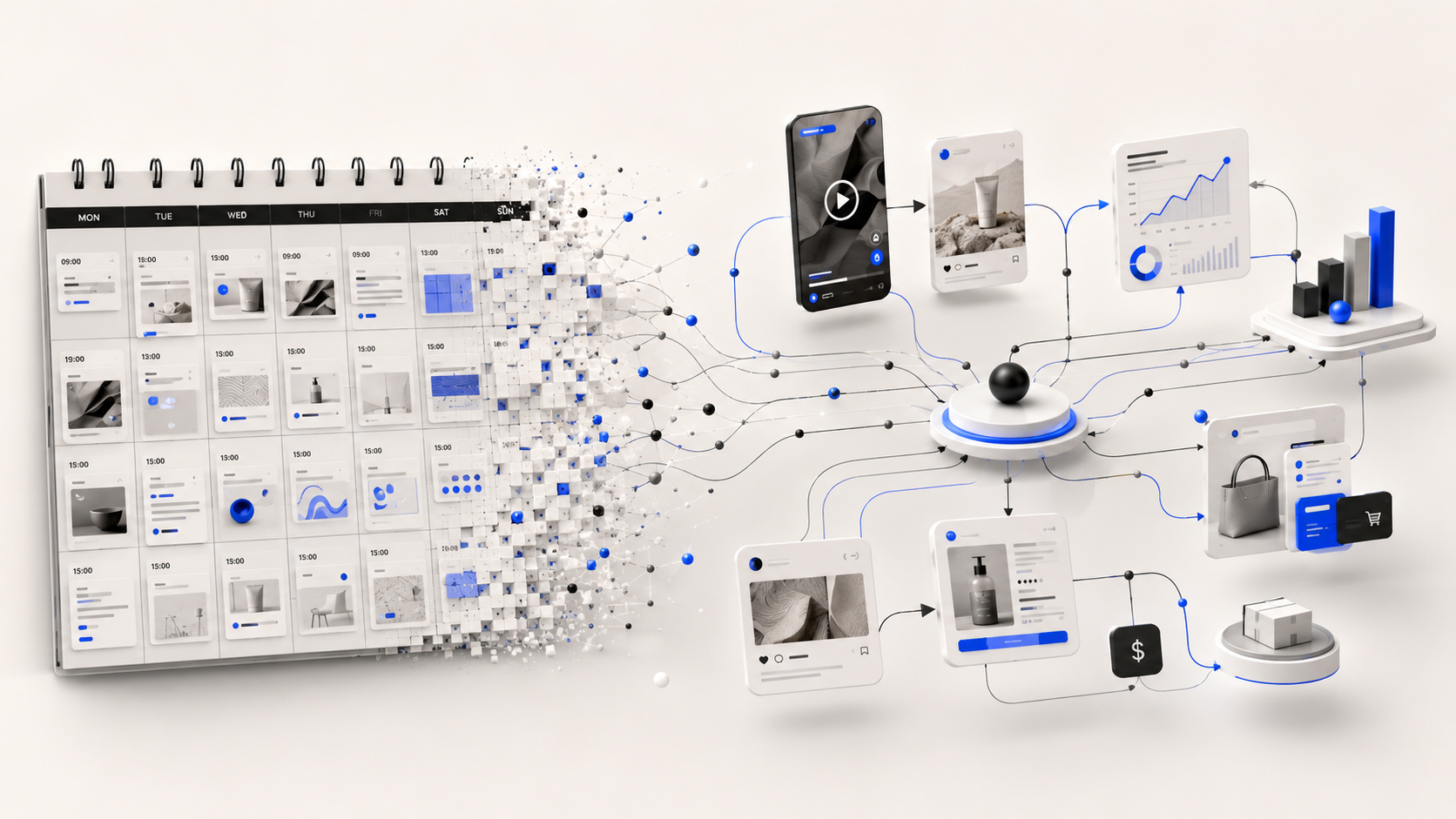
One of the biggest changes in social media marketing is not happening within a single platform or format. It is happening between them. Organic social, creator marketing, and paid media were once treated as separate channels with different teams, budgets, and objectives. In 2026, those boundaries are increasingly artificial, as the same piece of content can move between all three and play a different role at every stage.
Creator content is at the center of this shift. A partnership that starts as an organic TikTok or Instagram Reel can get paid creative, reach new audiences through amplification, and generate performance data that influences the next campaign. At the same time, brands are increasingly producing creator-style assets specifically for paid distribution, without relying on organic performance first. Marketing Week describes this emerging model as an integrated effectiveness system, where organic content creates credibility while paid media provides scale, targeting, and greater commercial predictability.
This fundamentally changes how brands should think about content performance. Under the traditional model, an organic post that receives fewer views than expected may be labeled unsuccessful. But organic reach tells only part of the story. A piece of content with modest engagement may contain a hook, product demonstration, creator perspective, or message that performs extremely well when shown to a different audience through paid media. Likewise, the most viral piece of content is not automatically the one most likely to drive consideration or sales. Attention and effectiveness are related, but they are not the same thing. The most viral post is not always the one that moves a customer closer to a purchase.
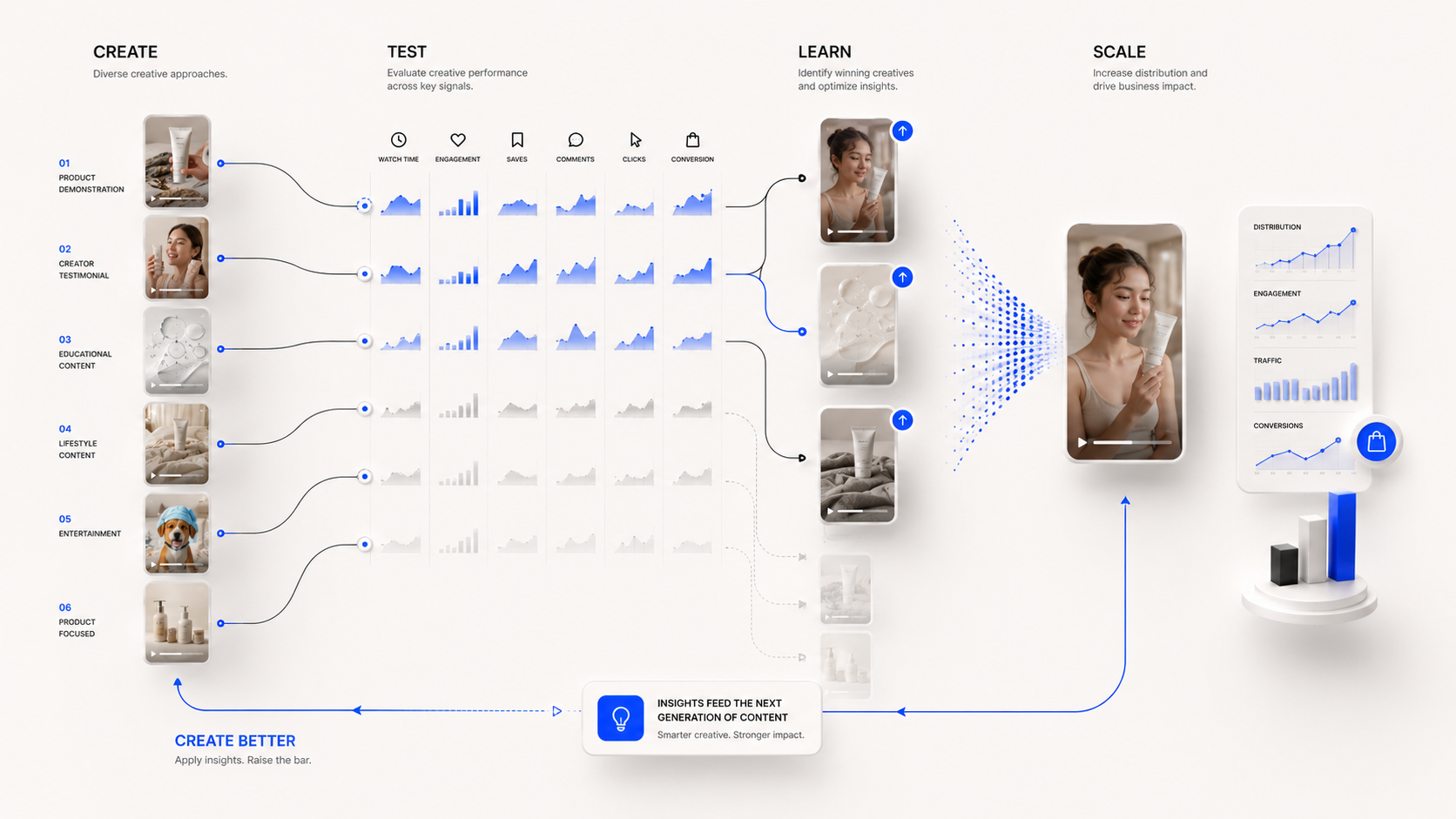
This is why high-performing social strategies are becoming more iterative. Organic content can function as a testing environment where brands learn which topics, formats, messages, and creative directions resonate with audiences. Creator partnerships introduce new voices and allow brands to test how products are interpreted outside their own communication style. Paid media can then scale promising ideas, while conversion data reveals whether that attention translates into meaningful business outcomes. Instead of each channel producing its own isolated results, every stage creates information that improves the next.
For global brands, connecting these functions is particularly important. A campaign that performs in Korea may require completely different creative cues, creators, or messaging to succeed in the US. Simply handing finished assets to a US marketing agency for distribution misses much of the opportunity. The stronger approach is to connect local market understanding with content development, creator strategy, media distribution, and performance analysis from the beginning. This is where the role of a global marketing agency is also changing: the value increasingly lies not in managing more channels, but in understanding how those channels work together.
The same shift applies to content production itself. Brands searching for a top global content creation agency increasingly need more than a team capable of producing visually strong assets. Content has to be built with distribution in mind. Some assets need to earn organic attention, others need to build creator-led trust, and others should be designed specifically for paid conversion. The strongest strategies understand these differences while allowing insights to move freely between them.
This creates a very different model from the traditional content calendar. Social media is no longer a sequence of posts with individual KPIs. It becomes an interconnected system where creative ideas are continuously produced, tested, distributed, measured, and improved. And once social begins operating this way, the question is no longer simply which content performed best. The more valuable question is what did that performance teach us about what to create, scale, and invest in next?
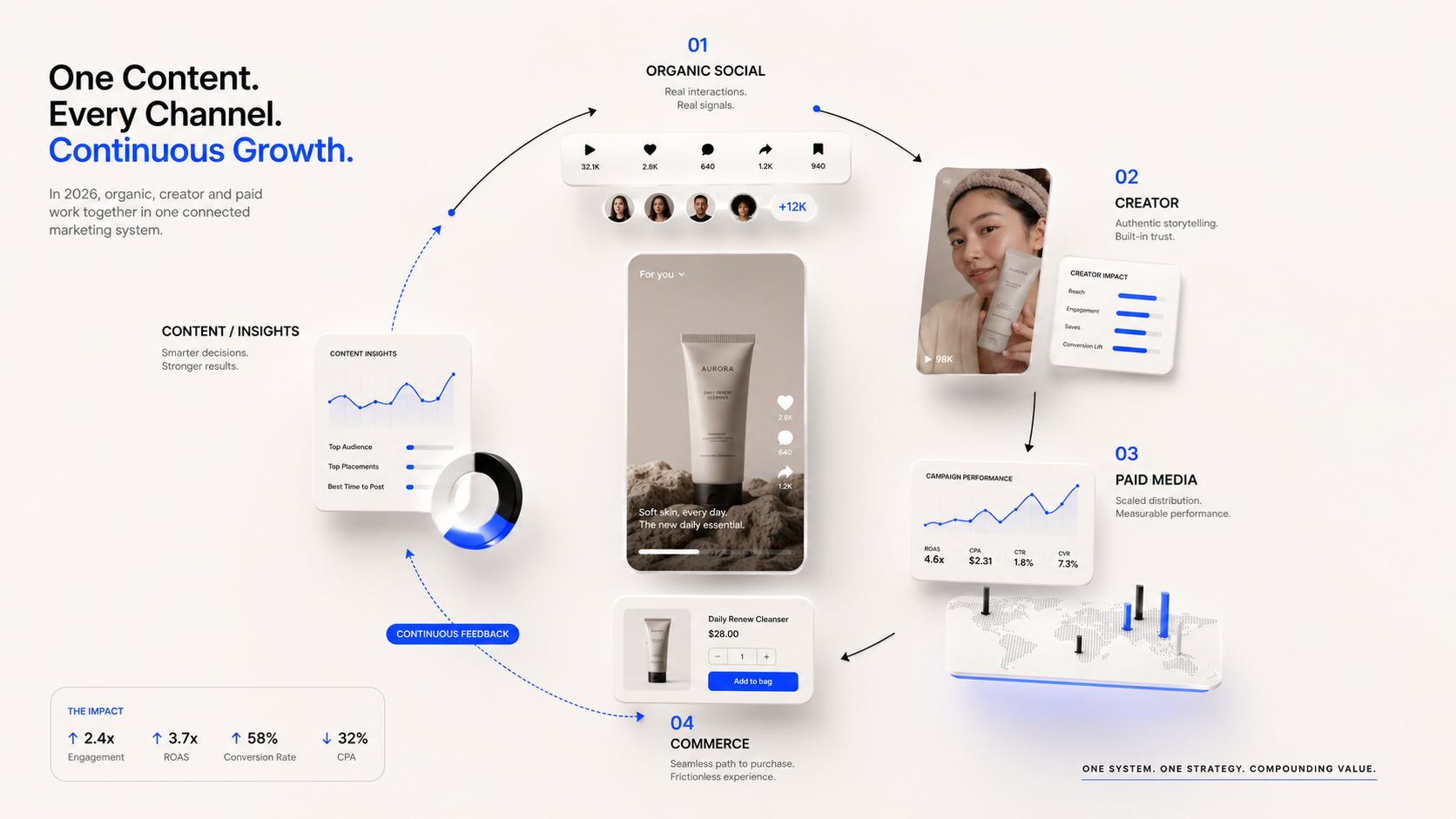
As social media becomes more connected to performance, the value of content is changing with it. For years, brands judged social content largely by what happened after publication: views, likes, comments, shares, and follower growth. These metrics still matter, but they only describe what happened on the surface. In 2026, the bigger opportunity lies in understanding what those signals can teach a brand about what to create, distribute, and invest in next.
Every piece of social content is effectively a live experiment. A product demonstration can reveal which benefit attracts the most attention. A creator video can show whether audiences respond better to education, entertainment, or personal experience. Comments can expose objections that were missing from the original strategy, while watch time can show whether the opening hook was strong enough to keep people interested. Instead of treating these results as numbers to place in a monthly report, high-performing teams use them as inputs for the next marketing decision.
This is particularly important as algorithms make reach less predictable. Digiday's 2026 creator research shows that marketers themselves are divided over what creator success should look like, with impressions and conversions almost equally likely to be named as the primary measurement. At the same time, brands such as Duolingo are shifting away from selecting creators primarily for their follower reach and focusing more heavily on whether the content itself is likely to perform algorithmically. The implication is significant: distribution power is increasingly determined by the strength of the content, not simply by the size of the audience attached to it.
However, this does not mean that the post with the highest views should automatically receive more budget. Attention and commercial value are not interchangeable. Marketing Week points to effectiveness testing where creator content with fewer organic views significantly outperformed a more-viewed alternative on deeper measures such as brand consideration, emotional response, and memory. The smarter question is therefore not simply "Which post performed best?" but "Which signal matters for the objective we are trying to achieve?"
Different goals call for different signals, not one universal KPI. For awareness, that may be reach, watch time, or brand recall. For consideration, saves, profile activity, product-page visits, search behavior, and repeated exposure may become more useful. Closer to conversion, marketers can look at click-through rates, acquisition costs, purchases, and ROAS. What matters is connecting the metric to the role the content was designed to play rather than forcing every social asset to prove itself through the same KPI.
This is where a global marketing agency can create value beyond simply managing channels. The role is increasingly about connecting creative judgment with performance data, particularly when brands operate across markets where the same message can produce very different responses. A US marketing agency might identify which creative drives conversion locally, while a broader global strategy needs to understand why it worked, which elements can travel, and which depend on specific cultural or platform behavior.
The same principle should influence how brands evaluate a top global content creation agency. Producing more assets faster is useful, but production efficiency alone is not a growth strategy. The stronger capability is creating a feedback loop where audience behavior informs creative decisions, creative decisions generate new performance data, and that data continuously improves what comes next. This is what turns social media from a content operation into a growth system. The competitive advantage is no longer simply the ability to publish consistently or react quickly to trends. It is the ability to learn faster from every piece of content, and turn those learnings into the next business decision.
The biggest shift in social media marketing in 2026 is ultimately not about content formats, algorithms, or even creators. It is about how brands structure social media within the wider business. For years, the content calendar provided a useful operating model: plan the month, produce the assets, publish them, report the results, and start again. But as social becomes increasingly connected to discovery, creative testing, paid distribution, and commerce, this linear approach leaves too much value behind.
A social-to-sales system works differently. Content is still planned and produced, but publication is no longer the end goal. Audience response becomes data that informs what happens next. Strong creative ideas can be developed further, creator content can move into paid media, successful formats can be scaled, and weaker approaches can be adjusted or replaced. Over time, every cycle should make the next one smarter. This is what turns social media from an ongoing production expense into an asset that can contribute to measurable growth.
The difference can already be seen in how brands are evolving their social operations. In Disrupt's work with Colorgram, for example, TikTok management began with research into platform behavior, trends, and audience interests, followed by a content mix that combined product storytelling with native formats, memes, and emerging creative approaches. But the strategy did not stop once the content was published. From the second month, performance was continuously analyzed across metrics including views, completion rate, engagement, and format effectiveness. High-performing formats were expanded while weaker ones were refined or replaced. The result was a 94% increase in follower growth rate, alongside increases of 169% in comments, 470% in shares, and 130% in likes.
Voice Caddie demonstrates what happens when this thinking extends beyond social media itself. Entering the highly competitive US market required more than producing localized posts. Disrupt connected content production, organic social, influencer activity, Meta advertising, and Amazon marketing while continuously using performance data to refine the strategy. Content produced in Korea was deliberately developed for American audiences and reused across social media, advertising, Amazon, and the brand's website. Performance from previous content shoots was then analyzed to shape the next round of production. The wider strategy contributed to a 278% increase in Shopify revenue, Meta ROAS above 4.0, and a 109x increase in average monthly Amazon sales.
These examples highlight an important distinction. Integration does not mean simply using more channels. A brand can hire a US marketing agency, run influencer campaigns, maintain multiple social accounts, and invest heavily in paid media while those activities remain disconnected. The advantage comes when information moves between them: when social insights influence creative, creative performance informs paid investment, paid results shape future production, and each market provides learnings that improve the wider strategy.
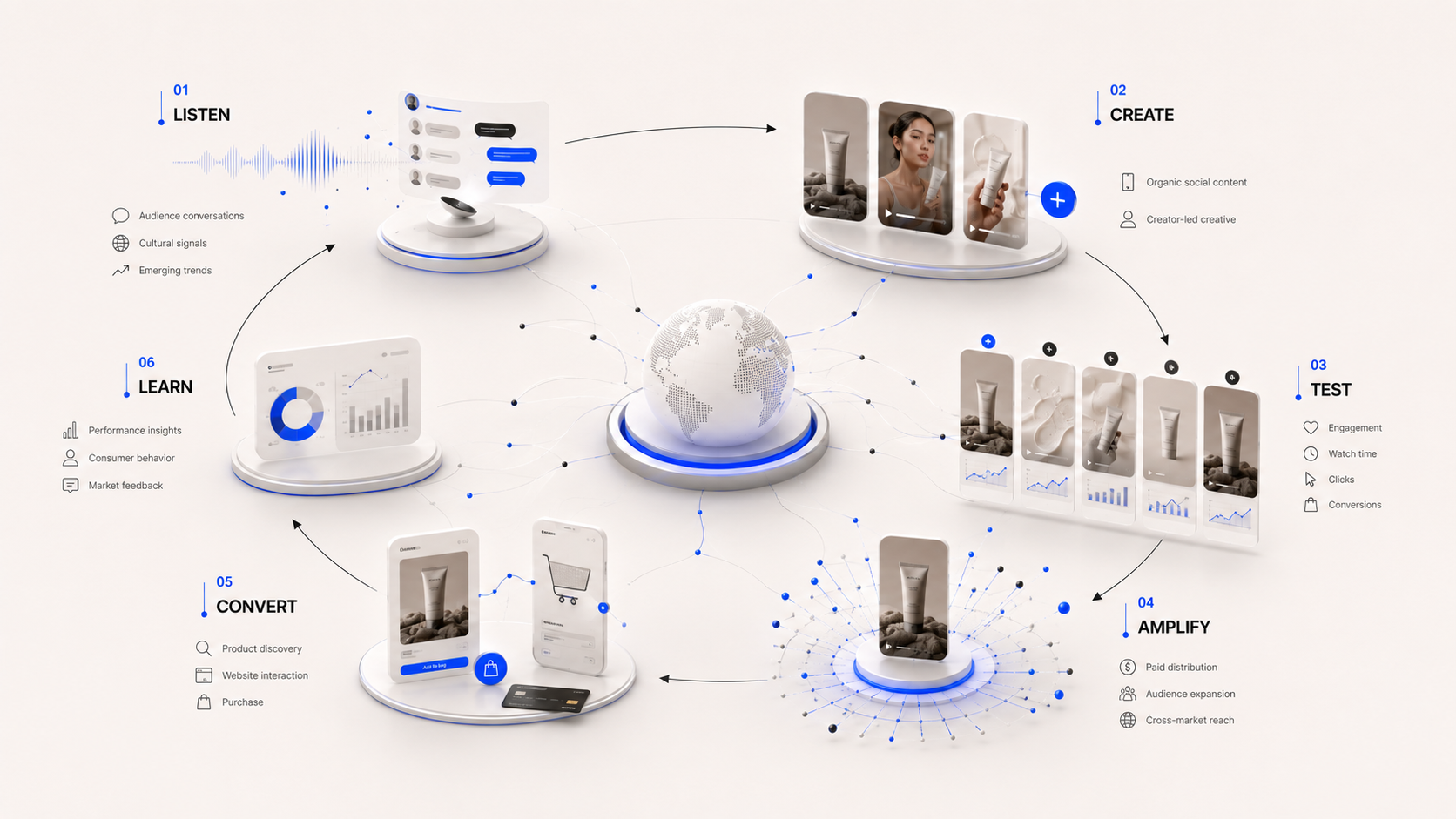
Real integration happens when insights move freely between every channel, not when more channels are simply added. This is also where the role of a global marketing agency is evolving. Brands do not necessarily need more content or more campaigns. They need fewer gaps between strategy, production, distribution, and performance. The same applies when choosing a top global content creation agency: creative quality matters, but its commercial value increases significantly when the team producing the content understands how that content will be distributed, measured, optimized, and ultimately connected to growth.
The content calendar will remain part of social media marketing. But in the strongest organizations, it will become just one layer of a much larger system. Because the brands that win in 2026 will not be the ones that simply publish the most consistently. They will be the ones that can turn every piece of content into insight, every insight into a smarter decision, and every decision into a stronger path from social to sales.